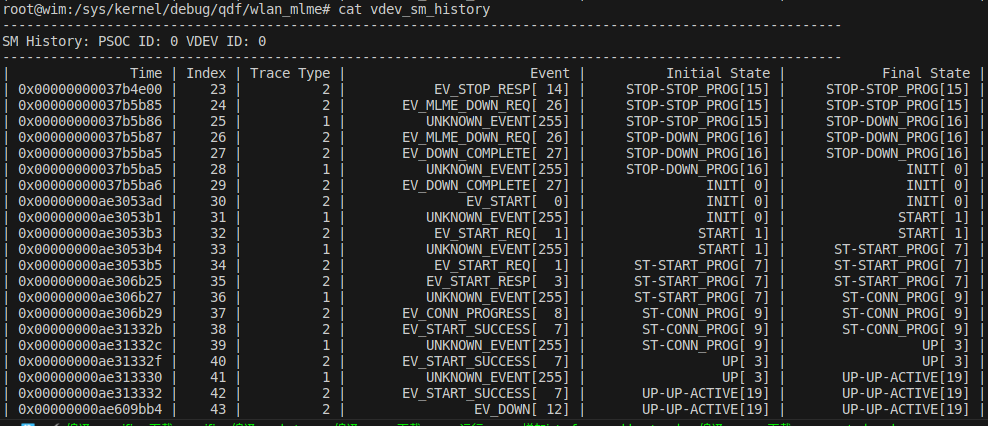
驱动层WALN 状态机运行机制
wlan_sm 状态机基类介绍
状态机基本struct信息
状态机信息结构体:
struct wlan_sm_state_infostruct wlan_sm_state_info { uint8_t state; // 当前状态 uint8_t parent_state; // 父状态 uint8_t initial_substate; // 子状态 uint8_t has_substates; // 是否有子状态标志 const char *name; // 状态的名字 void (*wlan_sm_entry) (void *ctx);// entry回调 void (*wlan_sm_exit) (void *ctx);// exit回调 bool (*wlan_sm_event) (void *ctx, uint16_t event,uint16_t event_data_len, void *event_data);/// 事件回调 };
比如我们定义一个状态机的时候,首先定义各个状态对应的
struct wlan_sm_state_info,如下:struct wlan_sm_state_info sm_info[] = { { (uint8_t)WLAN_VDEV_S_INIT, (uint8_t)WLAN_SM_ENGINE_STATE_NONE, (uint8_t)WLAN_SM_ENGINE_STATE_NONE, true, "INIT", mlme_vdev_state_init_entry, mlme_vdev_state_init_exit, mlme_vdev_state_init_event }, { (uint8_t)WLAN_VDEV_S_START, (uint8_t)WLAN_SM_ENGINE_STATE_NONE, (uint8_t)WLAN_SM_ENGINE_STATE_NONE, true, "START", mlme_vdev_state_start_entry, mlme_vdev_state_start_exit, mlme_vdev_state_start_event } };
状态机事件名字
事件名字代表事件的字符串表达
static const char *vdev_sm_event_names[] = {
	"EV_START",
	"EV_START_REQ",
	"EV_RESTART_REQ",
};
状态机结构体:
struct wlan_smstruct wlan_sm { uint8_t name[WLAN_SM_ENGINE_MAX_NAME]; // 该状态机的名字 uint8_t cur_state;// 当前状态 uint8_t num_states;// 该状态机一共有多少个状态 uint8_t last_event;// 上次事件 struct wlan_sm_state_info *state_info;// 该状态机的 状态信息,里面存放着每个状态的 回调函数 具体参见 struct wlan_sm_state_info void *ctx;// 用户指针 qdf_atomic_t in_state_transition;// 锁 const char **event_names;// 该状态机所拥有的所有事件名字数组 就是上面第2部提到的 static const char *vdev_sm_event_names[] uint32_t num_event_names;// 一共多少个事件,取决于 static const char *vdev_sm_event_names[] 数组的大小 #ifdef SM_ENG_HIST_ENABLE struct wlan_sm_history history;// 用来记录状态机变迁的历史记录 #endif };
状态机api函数
创建状态机函数
/**
 * wlan_sm_create() - SM create
 * @name: 该状态机名字
 * @ctx: caller pointer:用户指针
 * @init_state: 默认初始化状态
 * @state_info:状态机信息。里面存放各个状态对应的回调函数
 * @num_state: 该状态机一共有多少个状态
 * @event_names:事件表对应的名字
 * @num_event_names: 一共有多少个事件
 *
 * 创建状态机
 *
 * Return:  struct wlan_sm 句柄
 *                   NULL 创建失败
 */
struct wlan_sm *wlan_sm_create(const char *name, void *ctx,
			       uint8_t init_state,
			       struct wlan_sm_state_info *state_info,
			       uint8_t num_states,
			       const char **event_names,
			       uint32_t num_event_names);
{
	struct wlan_sm *sm;
	u_int32_t i;
    // 创建内存
	sm = qdf_mem_malloc(sizeof(*sm));

    // 保存历史相关
	wlan_sm_history_init(sm);

    // 把 传入参数传入 到sm 结构体中
	sm->cur_state = init_state;
	sm->num_states = num_states;
	sm->state_info = state_info;
	sm->ctx = ctx;
	sm->last_event = WLAN_SM_ENGINE_EVENT_NONE;
	qdf_atomic_set(&sm->in_state_transition, 0); // 初始化锁
	sm->event_names = event_names;
	sm->num_event_names = num_event_names;

	qdf_str_lcopy(sm->name, name, WLAN_SM_ENGINE_MAX_NAME);


	return sm;
}
删除状态机
void wlan_sm_delete(struct wlan_sm *sm)
{
	wlan_sm_history_delete(sm); // 删除历史相关
	qdf_mem_free(sm); // 直接释放sm内存
}
状态机事件dispatch
/**
 * wlan_sm_dispatch() - API to notify event to SM
 * @sm: 状态机句柄
 * @event: 事件id
 * @event_data_len: 事件数据长度
 * @event_data: 事件数据
 *
 * 通知事件到 状态机sm,并回调对应状态下的函数
 *
 * Return: QDF_STATUS_SUCCESS  处理成功
 *                 QDF_STATUS_E_INVAL 处理失败
 */
QDF_STATUS wlan_sm_dispatch(struct wlan_sm *sm, uint16_t event,
			    uint16_t event_data_len, void *event_data)
{
	bool event_handled = false;
	uint8_t state;
	const char *event_name = NULL;

	state = sm->cur_state;
	// 记录 上此发生的事件
	sm->last_event = event;

    // 记录历史
	wlan_sm_save_history(sm, SM_EVENT_MSG_PROCESSING, sm->cur_state,sm->cur_state, event);

    // 如果当前状态不为空,找到 该状态下event 处理函数 wlan_sm_event,进行 回调 这里 并没有 进行转态变迁,只是做了wlan_sm_event的回调
	if (state != WLAN_SM_ENGINE_STATE_NONE) {
        // 回调当前状态下的 wlan_sm_event 函数
		event_handled = (*sm->state_info[state].wlan_sm_event) (sm->ctx, event, event_data_len, event_data);
		if (!event_handled) {
			sm_engine_nofl_info("%s: event %d not handled in state %s",
					    sm->name, event,
					    sm->state_info[sm->cur_state].name);
			return QDF_STATUS_E_INVAL;
		}
	}

	return QDF_STATUS_SUCCESS;
}
从上面的分析可以看出
该函数记录上次发生了什么事件
sm->last_event = event;该函数只调用了事件的处理函数
wlan_sm_event,并没有进行任何状态的变迁, 当然在wlan_sm_event函数中 有可能进行状态变迁
状态机传输函数,变迁状态到新的状态
/**
 * wlan_sm_transition_to() - API to move the state of SM
 * @sm: 状态机处理句柄
 * @state: 将要变迁到的状态
 */
void wlan_sm_transition_to(struct wlan_sm *sm, uint8_t state)
{
	struct wlan_sm_state_info *state_info;
	uint8_t new_state;
	uint8_t old_state;
	uint8_t new_sub_st;
	uint8_t ol_sub_st;
	uint8_t cur_state;


	state_info = sm->state_info;
	cur_state = sm->cur_state;

	/*
	*   cannot change state from state entry/exit routines
	* 不能够在状态enrty或者exit中 执行 转态变迁,锁子呢在
    */
	if (qdf_atomic_read(&sm->in_state_transition)) {
		sm_engine_alert(
			"%s: can not call state transition from entry/exit routines",
					sm->name);
		QDF_BUG(0);
		return;
	}
	// 上锁
	qdf_atomic_set(&sm->in_state_transition, 1);

    // 保存历史
	wlan_sm_save_history(sm, SM_EVENT_STATE_TRANSITION, sm->cur_state,state, 0xFF);

    // 新状态合法性检查
	if ((state == WLAN_SM_ENGINE_STATE_NONE) ||
	    (state >= WLAN_SM_ENGINE_MAX_STATES) ||
	    (state >= sm->num_states)) {
		sm_engine_err(
			"%s: to state %d needs to be a valid state current_state=%d",
					sm->name, cur_state, state);
		return;
	}

	/*
	 * Here state and sub state are derived for debug printing only
	 * as SME keeps state and sub state as flat, to differentiate between
	 * state and substate, checks current state if it has parent state,
	 * the parent state is printed along with the sub state
	 */
    // 下面这一堆 没什么用,只是用来打印,
    // 思想就是
   /*
    *old_state  																ol_sub_st
   * state_info[cur_state].parent_state;             cur_state             情况1 当前状态有 父状态
    * cur_state                                                                          0                    情况2 当前状态没有 父状态
  */

    /*
	* new_state  												new_sub_st
  	* state_info[state].parent_state;             state              情况1 将要变迁状态  有 父状态
    * state                                                                     0   				情况2 将要变迁状态 没有 父状态
    */
	if (state_info[cur_state].parent_state != WLAN_SM_ENGINE_STATE_NONE)
		old_state = state_info[cur_state].parent_state;
	else
		old_state = cur_state;

	if (state_info[state].parent_state != WLAN_SM_ENGINE_STATE_NONE)
		new_state = state_info[state].parent_state;
	else
		new_state = state;

	if (state_info[cur_state].parent_state != WLAN_SM_ENGINE_STATE_NONE)
		ol_sub_st = cur_state;
	else
		ol_sub_st = 0;

	if (state_info[state].parent_state != WLAN_SM_ENGINE_STATE_NONE)
		new_sub_st = state;
	else
		new_sub_st = 0;

	sm_engine_nofl_debug("%s: %s > %s, %s > %s", sm->name,
			     state_info[old_state].name,
			     state_info[new_state].name,
			     ol_sub_st ? state_info[ol_sub_st].name : "IDLE",
			     new_sub_st ? state_info[new_sub_st].name : "IDLE");

	/*
	 * 要从 cur_state 变迁到  新的状态 state
	 * 调用 cur_state 下的 退出函数 wlan_sm_exit
	 * 如果 cur_state 有父状态,顺序 调用 他的父状态 的退出函数
	 */
	while (cur_state != WLAN_SM_ENGINE_STATE_NONE) {
		if (state_info[cur_state].wlan_sm_exit)
			state_info[cur_state].wlan_sm_exit(sm->ctx);

		cur_state = state_info[cur_state].parent_state;
	}

	/*
	 * 要从 cur_state 变迁到  新的状态 state
	 * 调用 state 下的 进入函数 wlan_sm_entry
	 * 如果 state 有子状态,顺序 调用 他的子状态 的进入函数
	 * 并且 把状态机的sm->cur_state 更新为最后一次调用的 状态,如果最后一次是子状态,就赋值为子状态,
	 */
	cur_state = state;
	while (cur_state != WLAN_SM_ENGINE_STATE_NONE) {
		if (state_info[cur_state].wlan_sm_entry)
			state_info[cur_state].wlan_sm_entry(sm->ctx);

		sm->cur_state = cur_state;
		cur_state = state_info[cur_state].initial_substate;

		if (cur_state != WLAN_SM_ENGINE_STATE_NONE)
			sm_engine_nofl_debug("%s: Initial sub state %s",
					     sm->name,
					     state_info[cur_state].name);
	}
    // 解锁
	qdf_atomic_set(&sm->in_state_transition, 0);
}
从上面的分析可以看出:
该函数先调用当前状态sm->cur_state的退出函数,如果有父状态,顺序调用它父亲的退出函数;
调用要变迁的状态state 的进入函数,如果有子状态,也调用它的子状态的进入函数,并且把 状态机的 当前状态 变迁到 state(ps:如果有子状态就是 子状态)
得到上次的事件
uint8_t wlan_sm_get_lastevent(struct wlan_sm *sm)
{
	return sm->last_event;
}
得到当前状态
uint8_t wlan_sm_get_current_state(struct wlan_sm *sm)
{
	return sm->cur_state;
}
得到状态的名字
const char *wlan_sm_get_state_name(struct wlan_sm *sm, uint8_t state)
{
	return sm->state_info[state].name;
}
得到当前状态的名字
const char *wlan_sm_get_current_state_name(struct wlan_sm *sm)
{
	return sm->state_info[sm->cur_state].name;
}
wlan_sm 状态机示例mlme状态机
创建状态机
QDF_STATUS mlme_vdev_sm_create(struct vdev_mlme_obj *vdev_mlme)
{
	struct wlan_sm *sm;
	uint8_t name[WLAN_SM_ENGINE_MAX_NAME];
	struct wlan_objmgr_vdev *vdev = vdev_mlme->vdev;

   qdf_scnprintf(name, sizeof(name), "VDEV%d-MLME",wlan_vdev_get_id(vdev_mlme->vdev));
  // 创建状态机,
  // 状态机名字为 VDEV%d-MLME
  // 初始化状态为 WLAN_VDEV_S_INIT
  // 状态信息表为 sm_info
  // 状态机事件名字为 vdev_sm_event_names
	sm = wlan_sm_create(name, vdev_mlme,
			    WLAN_VDEV_S_INIT,
			    sm_info,
			    QDF_ARRAY_SIZE(sm_info),
			    vdev_sm_event_names,
			    QDF_ARRAY_SIZE(vdev_sm_event_names));

	vdev_mlme->sm_hdl = sm;

	return QDF_STATUS_SUCCESS;
}
上面函数提到的mlme状态机的:
状态信息表:
struct wlan_sm_state_info sm_info[] = {
	{
		(uint8_t)WLAN_VDEV_S_INIT,
		(uint8_t)WLAN_SM_ENGINE_STATE_NONE,
		(uint8_t)WLAN_SM_ENGINE_STATE_NONE,
		true,
		"INIT",
		mlme_vdev_state_init_entry,
		mlme_vdev_state_init_exit,
		mlme_vdev_state_init_event
	},
	{
		(uint8_t)WLAN_VDEV_S_START,
		(uint8_t)WLAN_SM_ENGINE_STATE_NONE,
		(uint8_t)WLAN_SM_ENGINE_STATE_NONE,
		true,
		"START",
		mlme_vdev_state_start_entry,
		mlme_vdev_state_start_exit,
		mlme_vdev_state_start_event
	},
	{
		(uint8_t)WLAN_VDEV_S_DFS_CAC_WAIT,
		(uint8_t)WLAN_SM_ENGINE_STATE_NONE,
		(uint8_t)WLAN_SM_ENGINE_STATE_NONE,
		true,
		"DFS_CAC_WAIT",
		mlme_vdev_state_dfs_cac_wait_entry,
		mlme_vdev_state_dfs_cac_wait_exit,
		mlme_vdev_state_dfs_cac_wait_event
	},
	{
		(uint8_t)WLAN_VDEV_S_UP,
		(uint8_t)WLAN_SM_ENGINE_STATE_NONE,
		(uint8_t)WLAN_SM_ENGINE_STATE_NONE,
		true,
		"UP",
		mlme_vdev_state_up_entry,
		mlme_vdev_state_up_exit,
		mlme_vdev_state_up_event
	},
	{
		(uint8_t)WLAN_VDEV_S_SUSPEND,
		(uint8_t)WLAN_SM_ENGINE_STATE_NONE,
		(uint8_t)WLAN_SM_ENGINE_STATE_NONE,
		true,
		"SUSPEND",
		mlme_vdev_state_suspend_entry,
		mlme_vdev_state_suspend_exit,
		mlme_vdev_state_suspend_event
	},
	{
		(uint8_t)WLAN_VDEV_S_STOP,
		(uint8_t)WLAN_SM_ENGINE_STATE_NONE,
		(uint8_t)WLAN_VDEV_SS_STOP_STOP_PROGRESS,
		true,
		"STOP",
		mlme_vdev_state_stop_entry,
		mlme_vdev_state_stop_exit,
		mlme_vdev_state_stop_event
	},
	{
		(uint8_t)WLAN_VDEV_S_MAX,
		(uint8_t)WLAN_SM_ENGINE_STATE_NONE,
		(uint8_t)WLAN_SM_ENGINE_STATE_NONE,
		false,
		"INVALID",
		NULL,
		NULL,
		NULL
	},
	{
		(uint8_t)WLAN_VDEV_SS_START_START_PROGRESS,
		(uint8_t)WLAN_VDEV_S_START,
		(uint8_t)WLAN_SM_ENGINE_STATE_NONE,
		false,
		"ST-START_PROG",
		mlme_vdev_subst_start_start_progress_entry,
		mlme_vdev_subst_start_start_progress_exit,
		mlme_vdev_subst_start_start_progress_event
	},
	{
		(uint8_t)WLAN_VDEV_SS_START_RESTART_PROGRESS,
		(uint8_t)WLAN_VDEV_S_START,
		(uint8_t)WLAN_SM_ENGINE_STATE_NONE,
		false,
		"ST-RESTART_PROG",
		mlme_vdev_subst_start_restart_progress_entry,
		mlme_vdev_subst_start_restart_progress_exit,
		mlme_vdev_subst_start_restart_progress_event
	},
	{
		(uint8_t)WLAN_VDEV_SS_START_CONN_PROGRESS,
		(uint8_t)WLAN_VDEV_S_START,
		(uint8_t)WLAN_SM_ENGINE_STATE_NONE,
		false,
		"ST-CONN_PROG",
		mlme_vdev_subst_start_conn_progress_entry,
		mlme_vdev_subst_start_conn_progress_exit,
		mlme_vdev_subst_start_conn_progress_event
	},
	{
		(uint8_t)WLAN_VDEV_SS_START_DISCONN_PROGRESS,
		(uint8_t)WLAN_VDEV_S_START,
		(uint8_t)WLAN_SM_ENGINE_STATE_NONE,
		false,
		"ST-DISCONN_PROG",
		mlme_vdev_subst_start_disconn_progress_entry,
		mlme_vdev_subst_start_disconn_progress_exit,
		mlme_vdev_subst_start_disconn_progress_event
	},
	{
		(uint8_t)WLAN_VDEV_SS_SUSPEND_SUSPEND_DOWN,
		(uint8_t)WLAN_VDEV_S_SUSPEND,
		(uint8_t)WLAN_SM_ENGINE_STATE_NONE,
		false,
		"SP-SUSPEND_DOWN",
		mlme_vdev_subst_suspend_suspend_down_entry,
		mlme_vdev_subst_suspend_suspend_down_exit,
		mlme_vdev_subst_suspend_suspend_down_event
	},
	{
		(uint8_t)WLAN_VDEV_SS_SUSPEND_SUSPEND_RESTART,
		(uint8_t)WLAN_VDEV_S_SUSPEND,
		(uint8_t)WLAN_SM_ENGINE_STATE_NONE,
		false,
		"SP-SUSPEND_RESTART",
		mlme_vdev_subst_suspend_suspend_restart_entry,
		mlme_vdev_subst_suspend_suspend_restart_exit,
		mlme_vdev_subst_suspend_suspend_restart_event
	},
	{
		(uint8_t)WLAN_VDEV_SS_SUSPEND_HOST_RESTART,
		(uint8_t)WLAN_VDEV_S_SUSPEND,
		(uint8_t)WLAN_SM_ENGINE_STATE_NONE,
		false,
		"SP-HOST_RESTART",
		mlme_vdev_subst_suspend_host_restart_entry,
		mlme_vdev_subst_suspend_host_restart_exit,
		mlme_vdev_subst_suspend_host_restart_event
	},
	{
		(uint8_t)WLAN_VDEV_SS_SUSPEND_CSA_RESTART,
		(uint8_t)WLAN_VDEV_S_SUSPEND,
		(uint8_t)WLAN_SM_ENGINE_STATE_NONE,
		false,
		"SP-CSA_RESTART",
		mlme_vdev_subst_suspend_csa_restart_entry,
		mlme_vdev_subst_suspend_csa_restart_exit,
		mlme_vdev_subst_suspend_csa_restart_event
	},
	{
		(uint8_t)WLAN_VDEV_SS_STOP_STOP_PROGRESS,
		(uint8_t)WLAN_VDEV_S_STOP,
		(uint8_t)WLAN_SM_ENGINE_STATE_NONE,
		false,
		"STOP-STOP_PROG",
		mlme_vdev_subst_stop_stop_progress_entry,
		mlme_vdev_subst_stop_stop_progress_exit,
		mlme_vdev_subst_stop_stop_progress_event
	},
	{
		(uint8_t)WLAN_VDEV_SS_STOP_DOWN_PROGRESS,
		(uint8_t)WLAN_VDEV_S_STOP,
		(uint8_t)WLAN_SM_ENGINE_STATE_NONE,
		false,
		"STOP-DOWN_PROG",
		mlme_vdev_subst_stop_down_progress_entry,
		mlme_vdev_subst_stop_down_progress_exit,
		mlme_vdev_subst_stop_down_progress_event
	},
	{
		(uint8_t)WLAN_VDEV_SS_IDLE,
		(uint8_t)WLAN_SM_ENGINE_STATE_NONE,
		(uint8_t)WLAN_SM_ENGINE_STATE_NONE,
		false,
		"IDLE",
		NULL,
		NULL,
		NULL,
	},
	{
		(uint8_t)WLAN_VDEV_SS_MLO_SYNC_WAIT,
		(uint8_t)WLAN_VDEV_S_UP,
		(uint8_t)WLAN_SM_ENGINE_STATE_NONE,
		false,
		"UP-MLO-SYNC-WAIT",
		mlme_vdev_subst_mlo_sync_wait_entry,
		mlme_vdev_subst_mlo_sync_wait_exit,
		mlme_vdev_subst_mlo_sync_wait_event
	},
	{
		(uint8_t)WLAN_VDEV_SS_UP_ACTIVE,
		(uint8_t)WLAN_VDEV_S_UP,
		(uint8_t)WLAN_SM_ENGINE_STATE_NONE,
		false,
		"UP-UP-ACTIVE",
		mlme_vdev_subst_up_active_entry,
		mlme_vdev_subst_up_active_exit,
		mlme_vdev_subst_up_active_event
	},
	{
		(uint8_t)WLAN_VDEV_SS_MAX,
		(uint8_t)WLAN_SM_ENGINE_STATE_NONE,
		(uint8_t)WLAN_SM_ENGINE_STATE_NONE,
		false,
		"INVALID",
		NULL,
		NULL,
		NULL,
	},
};
事件名字
static const char *vdev_sm_event_names[] = {
	"EV_START",
	"EV_START_REQ",
	"EV_RESTART_REQ",
	"EV_START_RESP",
	"EV_RESTART_RESP",
	"EV_START_REQ_FAIL",
	"EV_RESTART_REQ_FAIL",
	"EV_START_SUCCESS",
	"EV_CONN_PROGRESS",
	"EV_STA_CONN_START",
	"EV_DFS_CAC_WAIT",
	"EV_DFS_CAC_COMPLETED",
	"EV_DOWN",
	"EV_CONNECTION_FAIL",
	"EV_STOP_RESP",
	"EV_STOP_FAIL",
	"EV_DOWN_FAIL",
	"EV_DISCONNECT_COMPLETE",
	"EV_SUSPEND_RESTART",
	"EV_HOST_RESTART",
	"EV_UP_HOST_RESTART",
	"EV_FW_VDEV_RESTART",
	"EV_UP_FAIL",
	"EV_RADAR_DETECTED",
	"EV_CSA_RESTART",
	"EV_CSA_COMPLETE",
	"EV_MLME_DOWN_REQ",
	"EV_DOWN_COMPLETE",
	"EV_ROAM",
	"EV_STOP_REQ",
	"EV_CHAN_SWITCH_DISABLED",
	"EV_MLO_SYNC_COMPLETE",
};
所有状态
/**
 * enum wlan_vdev_state - VDEV state
 * @WLAN_VDEV_S_INIT:                     Default state, IDLE state
 * @WLAN_VDEV_S_START:                    START  state
 * @WLAN_VDEV_S_DFS_CAC_WAIT:             CAC period
 * @WLAN_VDEV_S_UP:                       UP state
 * @WLAN_VDEV_S_SUSPEND:                  Suspend state
 * @WLAN_VDEV_S_STOP:                     STOP state
 * @WLAN_VDEV_S_MAX:                      MAX state
 * @WLAN_VDEV_SS_START_START_PROGRESS:    Start progress sub state
 * @WLAN_VDEV_SS_START_RESTART_PROGRESS:  Restart progress sub state
 * @WLAN_VDEV_SS_START_CONN_PROGRESS:     Start connection progress sub state
 * @WLAN_VDEV_SS_START_DISCONN_PROGRESS:  Start Disconnection progress sub state
 * @WLAN_VDEV_SS_SUSPEND_SUSPEND_DOWN:    Suspend down sub state
 * @WLAN_VDEV_SS_SUSPEND_SUSPEND_RESTART: Suspend restart sub state
 * @WLAN_VDEV_SS_SUSPEND_HOST_RESTART:    Suspend host restart sub state
 * @WLAN_VDEV_SS_SUSPEND_CSA_RESTART:     Suspend CSA restart sub state
 * @WLAN_VDEV_SS_STOP_STOP_PROGRESS:      Stop progress sub state
 * @WLAN_VDEV_SS_STOP_DOWN_PROGRESS:      Stop down progress sub state
 * @WLAN_VDEV_SS_IDLE:                    Idle sub state (used, only if a state
 *                                        does not have substate)
 * @WLAN_VDEV_SS_MLO_SYNC_WAIT:           Sync wait sub state for MLO SAP
 * @WLAN_VDEV_SS_UP_ACTIVE:               Up active sub state
 * @WLAN_VDEV_SS_MAX:                     Max substate
 */
enum wlan_vdev_state {
	WLAN_VDEV_S_INIT = 0,
	WLAN_VDEV_S_START = 1,
	WLAN_VDEV_S_DFS_CAC_WAIT = 2,
	WLAN_VDEV_S_UP = 3,
	WLAN_VDEV_S_SUSPEND = 4,
	WLAN_VDEV_S_STOP = 5,
	WLAN_VDEV_S_MAX = 6,
	WLAN_VDEV_SS_START_START_PROGRESS = 7,
	WLAN_VDEV_SS_START_RESTART_PROGRESS = 8,
	WLAN_VDEV_SS_START_CONN_PROGRESS = 9,
	WLAN_VDEV_SS_START_DISCONN_PROGRESS = 10,
	WLAN_VDEV_SS_SUSPEND_SUSPEND_DOWN = 11,
	WLAN_VDEV_SS_SUSPEND_SUSPEND_RESTART = 12,
	WLAN_VDEV_SS_SUSPEND_HOST_RESTART = 13,
	WLAN_VDEV_SS_SUSPEND_CSA_RESTART = 14,
	WLAN_VDEV_SS_STOP_STOP_PROGRESS = 15,
	WLAN_VDEV_SS_STOP_DOWN_PROGRESS = 16,
	WLAN_VDEV_SS_IDLE = 17,
	WLAN_VDEV_SS_MLO_SYNC_WAIT = 18,
	WLAN_VDEV_SS_UP_ACTIVE = 19,
	WLAN_VDEV_SS_MAX = 20,
};
所有事件
/**
 * enum wlan_vdev_sm_evt - VDEV SM event
 * @WLAN_VDEV_SM_EV_START:               Start VDEV UP operation
 * @WLAN_VDEV_SM_EV_START_REQ:           Invokes VDEV START handshake
 * @WLAN_VDEV_SM_EV_RESTART_REQ:         Invokes VDEV RESTART handshake
 * @WLAN_VDEV_SM_EV_START_RESP:          Notification on START resp
 * @WLAN_VDEV_SM_EV_RESTART_RESP:        Notification on RESTART resp
 * @WLAN_VDEV_SM_EV_START_REQ_FAIL:      Notification on START req failure
 * @WLAN_VDEV_SM_EV_RESTART_REQ_FAIL:    Notification on RESTART req failure
 * @WLAN_VDEV_SM_EV_START_SUCCESS:       Notification of Join Success
 * @WLAN_VDEV_SM_EV_CONN_PROGRESS:       Invoke Connection/up process
 * @WLAN_VDEV_SM_EV_STA_CONN_START:      Invoke Station Connection process
 * @WLAN_VDEV_SM_EV_DFS_CAC_WAIT:        Invoke DFS CAC WAIT timer
 * @WLAN_VDEV_SM_EV_DFS_CAC_COMPLETED:   Notifies on CAC completion
 * @WLAN_VDEV_SM_EV_DOWN:                Invokes VDEV DOWN operation
 * @WLAN_VDEV_SM_EV_CONNECTION_FAIL:     Notifications for UP/connection failure
 * @WLAN_VDEV_SM_EV_STOP_RESP:           Notifcation of stop response
 * @WLAN_VDEV_SM_EV_STOP_FAIL:           Notification of stop req failure
 * @WLAN_VDEV_SM_EV_DOWN_FAIL:           Notification of down failure
 * @WLAN_VDEV_SM_EV_DISCONNECT_COMPLETE: Notification of Peer cleanup complete
 * @WLAN_VDEV_SM_EV_SUSPEND_RESTART:     Invokes suspend restart operation
 * @WLAN_VDEV_SM_EV_HOST_RESTART:        Invokes host only restart operation
 * @WLAN_VDEV_SM_EV_UP_HOST_RESTART:     Moves to UP state without sending UP
 *                                       command to lower layers
 * @WLAN_VDEV_SM_EV_FW_VDEV_RESTART:     Invokes FW only restart
 * @WLAN_VDEV_SM_EV_UP_FAIL:             Notification of up command failure
 * @WLAN_VDEV_SM_EV_RADAR_DETECTED:      Notification of RADAR detected, Random
 *                                       channel should be selected before
 *                                       triggering this event
 * @WLAN_VDEV_SM_EV_CSA_RESTART:         Invokes CSA IE operation
 * @WLAN_VDEV_SM_EV_CSA_COMPLETE:        Notifiction of CSA process complete
 * @WLAN_VDEV_SM_EV_MLME_DOWN_REQ:       Invoke DOWN command operation
 * @WLAN_VDEV_SM_EV_DOWN_COMPLETE:       Notification of DOWN complete
 * @WLAN_VDEV_SM_EV_ROAM:                Notifiction on ROAMING
 * @WLAN_VDEV_SM_EV_STOP_REQ:            Invoke API to initiate STOP handshake
 * @WLAN_VDEV_SM_EV_CHAN_SWITCH_DISABLED:Test only, CSA completes without
 *					 change in channel
 * @WLAN_VDEV_SM_EV_MLO_SYNC_COMPLETE:   MLO mgr triggers this event for the mlo
 *                                       sap in vdev wait up state, if all the
 *                                       links finish vdev start rsp.
 */
enum wlan_vdev_sm_evt {
	WLAN_VDEV_SM_EV_START = 0,
	WLAN_VDEV_SM_EV_START_REQ = 1,
	WLAN_VDEV_SM_EV_RESTART_REQ = 2,
	WLAN_VDEV_SM_EV_START_RESP = 3,
	WLAN_VDEV_SM_EV_RESTART_RESP = 4,
	WLAN_VDEV_SM_EV_START_REQ_FAIL = 5,
	WLAN_VDEV_SM_EV_RESTART_REQ_FAIL = 6,
	WLAN_VDEV_SM_EV_START_SUCCESS = 7,
	WLAN_VDEV_SM_EV_CONN_PROGRESS = 8,
	WLAN_VDEV_SM_EV_STA_CONN_START = 9,
	WLAN_VDEV_SM_EV_DFS_CAC_WAIT = 10,
	WLAN_VDEV_SM_EV_DFS_CAC_COMPLETED = 11,
	WLAN_VDEV_SM_EV_DOWN = 12,
	WLAN_VDEV_SM_EV_CONNECTION_FAIL = 13,
	WLAN_VDEV_SM_EV_STOP_RESP = 14,
	WLAN_VDEV_SM_EV_STOP_FAIL = 15,
	WLAN_VDEV_SM_EV_DOWN_FAIL = 16,
	WLAN_VDEV_SM_EV_DISCONNECT_COMPLETE = 17,
	WLAN_VDEV_SM_EV_SUSPEND_RESTART = 18,
	WLAN_VDEV_SM_EV_HOST_RESTART = 19,
	WLAN_VDEV_SM_EV_UP_HOST_RESTART = 20,
	WLAN_VDEV_SM_EV_FW_VDEV_RESTART = 21,
	WLAN_VDEV_SM_EV_UP_FAIL = 22,
	WLAN_VDEV_SM_EV_RADAR_DETECTED = 23,
	WLAN_VDEV_SM_EV_CSA_RESTART = 24,
	WLAN_VDEV_SM_EV_CSA_COMPLETE = 25,
	WLAN_VDEV_SM_EV_MLME_DOWN_REQ = 26,
	WLAN_VDEV_SM_EV_DOWN_COMPLETE = 27,
	WLAN_VDEV_SM_EV_ROAM = 28,
	WLAN_VDEV_SM_EV_STOP_REQ = 29,
	WLAN_VDEV_SM_EV_CHAN_SWITCH_DISABLED = 30,
	WLAN_VDEV_SM_EV_MLO_SYNC_COMPLETE = 31,
};
事件通知
QDF_STATUS mlme_vdev_sm_deliver_event(struct vdev_mlme_obj *vdev_mlme,
				      enum wlan_vdev_sm_evt event,
				      uint16_t event_data_len, void *event_data)
{
	return wlan_sm_dispatch(vdev_mlme->sm_hdl, event,event_data_len, event_data);
}
事件变迁
static void mlme_vdev_sm_transition_to(struct vdev_mlme_obj *vdev_mlme,
				       enum wlan_vdev_state state)
{
	wlan_sm_transition_to(vdev_mlme->sm_hdl, state);
}
保存状态机历史
上面我们注意到在状态机变迁或者事件分发函数中会有 wlan_sm_save_history(sm, SM_EVENT_MSG_PROCESSING, sm->cur_state,sm->cur_state, event)函数调用,
该函数就是用来保存状态机历史的,历史可以直接输出到屏幕,也可以保存到文件,下面以保存到文件为例说明:
基本结构体
enum wlan_sm_trace_type {
	SM_EVENT_STATE_TRANSITION = 1, // 在传输函数中 调用保存
	SM_EVENT_MSG_PROCESSING,         // 在事件通知函数中 调用保存
};

struct wlan_sm_history_info {
	enum wlan_sm_trace_type trace_type;   // 类型 参见enum wlan_sm_trace_type
	uint8_t event_type;  // 事件类型
	uint8_t initial_state; // 当前状态 Current state (state/sub-state)
	uint8_t final_state;   // 新状态
	uint64_t time;            // 事件戳
};

/**
 * struct wlan_sm_history - history structure
 * @sm_history_lock: SM history lock
 * @index:           Last updated entry index
 * @data:            Histoy elements array
 */
struct wlan_sm_history {
	qdf_spinlock_t sm_history_lock;
	uint8_t index; // 索引,默认最大50个  最大值参见 WLAN_SM_ENGINE_HISTORY_SIZE
	struct wlan_sm_history_info data[WLAN_SM_ENGINE_HISTORY_SIZE]; // 一共
};
解释:相当于定义了50个信息 struct wlan_sm_history_info结构体数组,然后保存一次,index++,最大的时候轮回。
api函数
保存到历史
void wlan_sm_save_history(struct wlan_sm *sm,
			  enum wlan_sm_trace_type trace_type,
			  uint8_t initial_state, uint8_t final_state,
			  uint16_t event_type)
{
	struct wlan_sm_history *p_sm_history = &sm->history;
	struct wlan_sm_history_info *p_memento;

	/*
	 * History saved in circular buffer.
	 * Save a pointer to next write location and increment pointer.
	 */
	qdf_spin_lock_bh(&p_sm_history->sm_history_lock);
    // 取出一个 data内存
	p_memento = &p_sm_history->data[p_sm_history->index];

    // 索引++ 并限幅
	p_sm_history->index++;
	p_sm_history->index %= WLAN_SM_ENGINE_HISTORY_SIZE;

	qdf_spin_unlock_bh(&p_sm_history->sm_history_lock);

    // 存放内容到 data内存中
	qdf_mem_zero(p_memento, sizeof(*p_memento));
	p_memento->trace_type = trace_type;
	p_memento->initial_state = initial_state;
	p_memento->final_state = final_state;
	p_memento->event_type = event_type;
	p_memento->time = qdf_get_log_timestamp();
}
直接打印历史
void wlan_sm_print_history(struct wlan_sm *sm)
{
	struct wlan_sm_history *p_sm_history = &sm->history;
	uint8_t i;
	uint8_t idx;

	/*
	 * History saved in circular buffer.
	 * Save a pointer to next write location and increment pointer.
	 */
	qdf_spin_lock_bh(&p_sm_history->sm_history_lock);


    // 从当前p_sm_history->index 开始,轮询打印 每个p_sm_history->data[idx]里面的内容
	for (i = 0; i < WLAN_SM_ENGINE_HISTORY_SIZE; i++) {
		idx = (p_sm_history->index + i) % WLAN_SM_ENGINE_HISTORY_SIZE;
		wlan_sm_print_history_entry(
			sm, &p_sm_history->data[idx], idx);
	}

	qdf_spin_unlock_bh(&p_sm_history->sm_history_lock);
}
输出历史到文件
// 文件句柄 m哪里来
void wlan_sm_print_fs_history(struct wlan_sm *sm, qdf_debugfs_file_t m)
{
	struct wlan_sm_history *p_sm_history = &sm->history;
	uint8_t i;
	uint8_t idx;

	/*
	 * History saved in circular buffer.
	 * Save a pointer to next write location and increment pointer.
	 */
	qdf_spin_lock_bh(&p_sm_history->sm_history_lock);

     // 从当前p_sm_history->index 开始,轮询输出 每个p_sm_history->data[idx]里面的内容到文件,那么是哪个文件,下面介绍
	for (i = 0; i < WLAN_SM_ENGINE_HISTORY_SIZE; i++) {
		idx = (p_sm_history->index + i) % WLAN_SM_ENGINE_HISTORY_SIZE;
		wlan_sm_print_fs_history_entry(sm, &p_sm_history->data[idx], idx, m);
	}

	qdf_spin_unlock_bh(&p_sm_history->sm_history_lock);
}

static void wlan_sm_print_fs_history_entry(struct wlan_sm *sm,
					   struct wlan_sm_history_info *ent,
					   uint16_t i, qdf_debugfs_file_t m)
{
	const char *event_name = NULL;
		qdf_debugfs_printf(
			m, "| 0x%016llx |%6d |%11d |%28d |%19s[%2d] |%19s[%2d] |\n",
			ent->time, i, ent->trace_type,
			ent->event_type,
			sm->state_info[ent->initial_state].name,
			ent->initial_state,
			sm->state_info[ent->final_state].name,
			ent->final_state);

}
// 该函数相当于写文件file
void qdf_debugfs_printf(qdf_debugfs_file_t file, const char *f, ...)
{
	va_list args;

	va_start(args, f);
	seq_vprintf(file, f, args);
	va_end(args);
}
文件创建地方
static struct qdf_debugfs_fops sm_dbg_buf_fops = {
   .show  = sm_dbg_fs_open,
   .write = sm_dbg_fs_write,
   .priv  = NULL,
};

qdf_dentry_t mlme_debugfs_entry;

static void wlan_sm_dbgfs_create(void)
{
    mlme_debugfs_entry = qdf_debugfs_create_dir("wlan_mlme", NULL);
    if (mlme_debugfs_entry) {
       if (!qdf_debugfs_create_file_simplified("vdev_sm_history",
                                               (QDF_FILE_USR_READ |
                                                QDF_FILE_GRP_READ |
                                                QDF_FILE_OTH_READ),
                                               mlme_debugfs_entry,
                                              &sm_dbg_buf_fops)) {
          qdf_err("debugfs entry creation failed!");
          return;
       }
    }
}
// 这里用了内核的 debugfs_create_file 相关内容,这里不做过多解释
// 总之会 在 /sys/kernel/debug/qdf/wlan_mlme 下创建 vdev_sm_history状态机,